

Is My Kid Too Young for an Orthodontist?

If you’re an Albuquerque parent who’s been eyeballing your child’s teeth and wondering whether it’s time to do something, you’re not alone. This is one of the most common quiet anxieties in pediatric dental waiting rooms across the city. You’re watching teeth come in at strange angles, you’re noticing a jaw that doesn’t seem to sit right, and your gut is saying something’s off – but you don’t know if you’re being a worried parent or a perceptive one.
This article is written for you. It answers the real questions – the ones parents actually have but don’t always know how to ask at a dentist appointment.
The Question Every Albuquerque Parent Asks: When Should My Child First See an Orthodontist?
Here’s the answer most people don’t expect: age 7.
The American Association of Orthodontists recommends that children have their first orthodontic screening by age 7. That number surprises parents – especially parents who are picturing braces, and who know their 7-year-old still has a mouth full of baby teeth.
But that’s exactly the point. The first orthodontic evaluation isn’t about putting braces on a second-grader. It’s about seeing the big picture while there’s still time to shape it.
At age 7, a child typically has a mix of baby teeth and incoming permanent teeth. An experienced Albuquerque orthodontist can use that window to assess jaw development, spot patterns that suggest future crowding, identify bite issues that are easier to correct during growth, and determine whether early intervention is warranted – or whether watchful waiting makes more sense.
Most kids who are seen at 7 are told: Come back in a year or two, everything looks fine for now. But for the kids who do have developing issues, catching them at this stage can mean shorter treatment later, less invasive correction, and sometimes the ability to avoid tooth extractions altogether.
The takeaway for Albuquerque parents: An age-7 screening isn’t about jumping into treatment. It’s about knowing what you’re working with before the window closes.
“My Dentist Hasn’t Mentioned It Yet” – Does That Mean Everything Is Fine?
Not necessarily. And this isn’t a knock on Albuquerque dentists – it’s just a reality of how different types of providers are trained.
Your child’s general dentist is focused on oral health: cavities, gum health, tooth development, fluoride, and hygiene habits. They see a lot in a short appointment. Orthodontic screening – the deep assessment of jaw relationships, bite patterns, and skeletal development – is a specialty skill. Many dentists are excellent at flagging obvious problems and making referrals, but the subtler early issues are what orthodontists are specifically trained to catch.
This means that waiting for your dentist to bring it up isn’t always the right strategy. If your child is approaching age 7, or if you’ve noticed any of the following, it’s worth scheduling a screening with an Albuquerque orthodontist directly:
- Teeth that look noticeably crowded, even while baby teeth are still in place
- A gap between front teeth that seems unusually wide
- Upper teeth that stick out significantly
- Lower jaw that seems to jut forward, or upper jaw that sits back
- Mouth breathing as a primary habit (especially during sleep)
- Difficulty chewing, or chewing primarily on one side
- Speech issues, particularly a lisp or difficulty with certain sounds
- Thumb sucking or pacifier use that continued past age 4
Any one of these is a reasonable reason to go get eyes on it. Most orthodontic consultations for children in Albuquerque are free. There is no downside to getting information.
What Is “Phase 1” Orthodontic Treatment – and Does My Kid Actually Need It?
If your child sees an Albuquerque orthodontist before age 10 and has a developing issue, you may hear the term Phase 1 treatment (also called early interceptive treatment). Understanding what this means – and when it’s genuinely necessary versus unnecessarily aggressive – is important.
Phase 1 treatment typically happens between ages 6 and 10, while baby teeth are still present. It might involve:
- A palate expander – a device that gently widens the upper jaw to create more room for incoming teeth or correct a crossbite
- Partial braces on select teeth to guide eruption or correct specific problems
- Space maintainers to hold space after an early tooth loss
- Functional appliances that influence jaw growth direction
Phase 2 treatment is what most people think of as “regular braces” – full comprehensive treatment that happens once all (or most) permanent teeth are in, typically in the early teen years.
Not every child needs Phase 1 treatment. A good Albuquerque orthodontist will be honest with you about whether early intervention will meaningfully change the outcome, or whether waiting for Phase 2 is equally effective. If you’re told your young child needs immediate, extensive treatment but you’re not given a clear explanation of why it can’t wait, a second opinion is entirely reasonable.
The goal of Phase 1, when it’s genuinely indicated, is to create conditions where Phase 2 is shorter, simpler, and sometimes avoidable altogether. Jaw expansion in a growing child, for example, is relatively straightforward – the same correction in an adult often requires surgery.
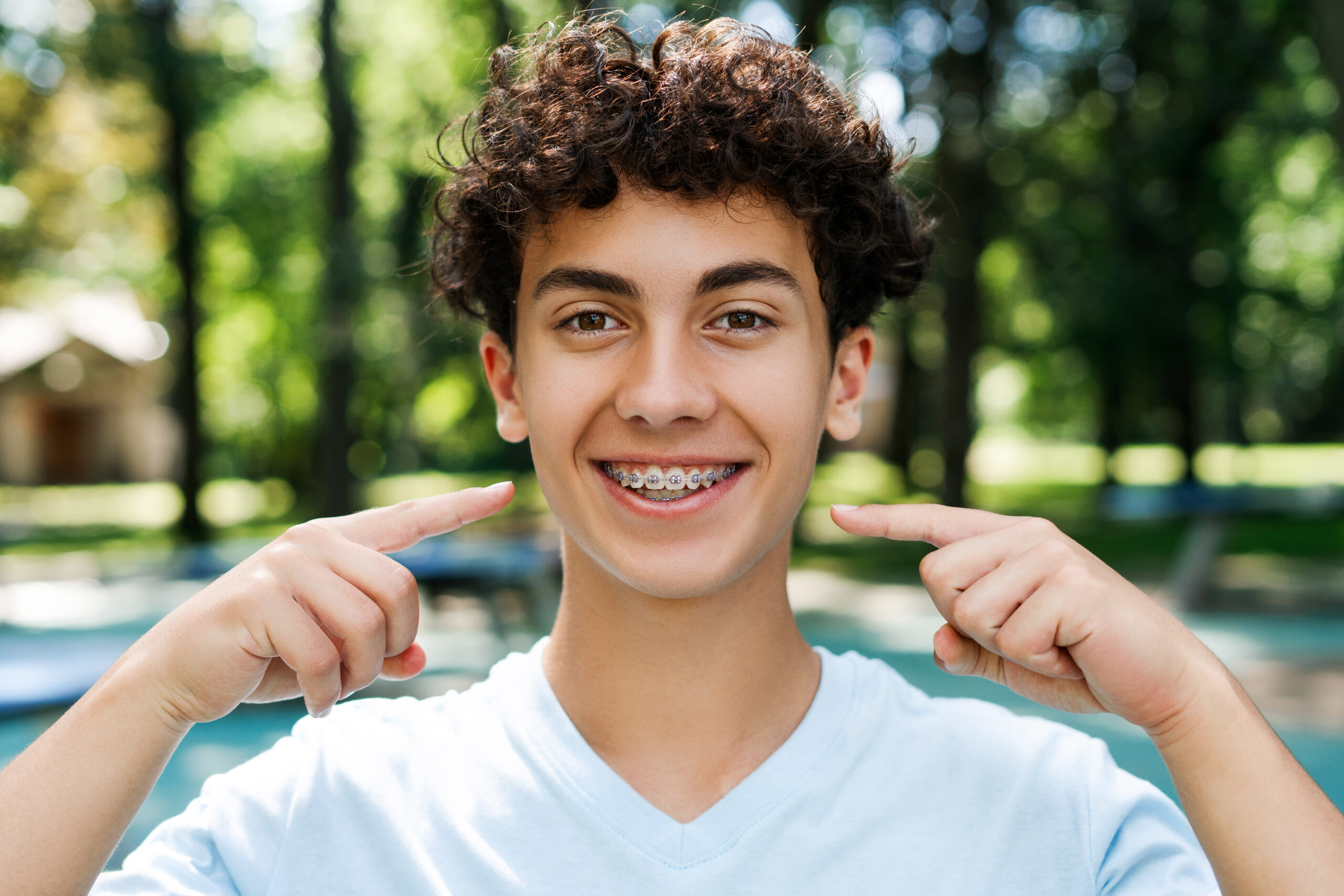
The Teen Years: What Albuquerque Parents Need to Know About Braces and Aligners for Adolescents
Most comprehensive orthodontic treatment in Albuquerque happens between ages 11 and 16 – the window when most permanent teeth have arrived, but the jaw is still in active growth. This is generally the most efficient time for treatment, and outcomes are typically excellent.
What to expect during teen treatment:
Comprehensive treatment usually takes 18 to 30 months, depending on complexity. Appointments are typically every 4 to 8 weeks. Your teen will need to maintain good oral hygiene – braces create more surfaces for plaque to hide, and Albuquerque orthodontists routinely see cavities develop during treatment in teens who aren’t brushing and flossing carefully. This is worth a real conversation before treatment starts.
Braces vs. Invisalign Teen:
Many Albuquerque orthodontists offer Invisalign Teen, a version of the clear aligner system designed specifically for adolescents with compliance indicators (small blue dots that fade to show wear time) and extra sets of replacement aligners for the inevitable losses.
The honest assessment: for motivated teens who will actually wear the aligners and take care of them, Invisalign Teen works very well. For teens who are likely to lose them, take them out at lunch and not put them back in, or feel peer pressure to go without them, traditional braces may produce more reliable results simply because they’re not optional. Talk honestly with your orthodontist about your teen’s personality and habits.
Adults in Albuquerque: “I Wish I’d Done This Sooner” Is the Most Common Thing Patients Say
This section is for the adults reading this who are here because of their kid’s appointment – but who have quietly wondered whether it’s too late for themselves.
It is not.
Adult orthodontic treatment in Albuquerque has grown significantly in the past decade, and the results speak for themselves. Teeth can be moved at any age. Bite problems can be corrected. Smiles can change.
What’s different about adult orthodontics:
- Bone density is higher in adults, which means teeth move more slowly. Treatment timelines are often longer than for teens.
- Gum health matters more. Adult patients with any history of gum disease need to have it under control before orthodontic treatment begins. Your Albuquerque dentist and orthodontist should communicate directly about this.
- Retention is non-negotiable. Adult teeth that have been in place for decades will try to return to their original positions. Permanent retainers (bonded to the back of teeth) are commonly recommended for adults.
- The emotional component is real. Adults often feel self-conscious about being in treatment, especially in professional settings. Clear aligners have made this far more manageable for many patients.
The cost is real, the time commitment is real, and the results are real. Albuquerque orthodontists who treat adults regularly see patients who describe it as one of the best investments they’ve made in themselves.
Questions Worth Asking Before You Choose an Albuquerque Orthodontist
Regardless of whether you’re seeking care for a child, a teenager, or yourself, the evaluation process matters. Here are questions that separate good consultations from great ones:
“What specifically are you seeing, and why does it need to be corrected now versus later?” A quality Albuquerque orthodontist will explain the clinical reasoning in plain language. “Your child has a crossbite that’s causing the lower jaw to shift to one side when biting – and correcting that now, during growth, is significantly easier than correcting it at 16” is a real answer. Vague urgency is not.
“What happens if we wait six months and reassess?” The answer tells you a lot. Some issues genuinely worsen with delay. Others are stable. Knowing who you’re dealing with helps you make a better-informed decision.
“What does retention look like after treatment is finished?” The end of active treatment is not the end of the commitment. Retainers are a lifetime thing. Know what you’re agreeing to.
“Do you coordinate with my general dentist?” Orthodontic treatment and general dental care overlap. Cavities need to be fixed before braces go on. Some procedures can’t happen while teeth are in active movement. A good Albuquerque orthodontist communicates proactively with your dentist – don’t assume that happens automatically.
The Bigger Picture: Why This Actually Matters Beyond Aesthetics
There’s a temptation to think of orthodontics as cosmetic – a “nice to have” if you can afford it, not a medical necessity. That framing misses a lot.
Bite problems left uncorrected can contribute to uneven tooth wear, chipping, and premature enamel loss. Jaw misalignment is linked to TMJ disorders – chronic jaw pain, clicking, and headaches that affect daily life. Crowded or overlapping teeth are harder to clean and carry a higher cavity and gum disease risk over a lifetime. Breathing patterns affected by palate structure have implications well beyond the mouth.
Orthodontic treatment, when it’s indicated, is not vanity. It’s addressing structural issues in a part of your body you use every single day, for every meal, every conversation, and every year of your life.
Albuquerque has the providers to do this well. The question is whether you give yourself or your child the chance to find out what’s actually going on.
See What’s Possible – Schedule with ABQ Orthodontics
At ABQ Orthodontics, we specialize in exactly this: catching issues early, explaining them clearly, and treating them well. Whether you’re bringing in a 7-year-old for a first screening, a teenager ready for braces, or an adult who’s been putting this off for years, we see patients at every stage and take every case seriously.
We offer free initial consultations because we believe the first step should be easy. Come in, ask every question you have, and leave with a real understanding of your options.
Book your free consultation at ABQ Orthodontics today. Call our office, request an appointment online, or walk in. The sooner you know what you’re working with, the sooner you can do something about it.


New Patients and Emergency Appointments Welcome
Albuquerque East Office
(505) 458-0132
Albuquerque West Office
(505) 451-7349